| ||||||||||||||||||||||||||||||
 | ||||||||||||||||||||||||||||||
|
login
|
 |
 |
 |
|
 |
|
 |
|
 |
 |
 |
|
|
|
|
Cell phone video cams start to have ‘reel’ feel Ability to take, not just watch, mobile video becoming more common
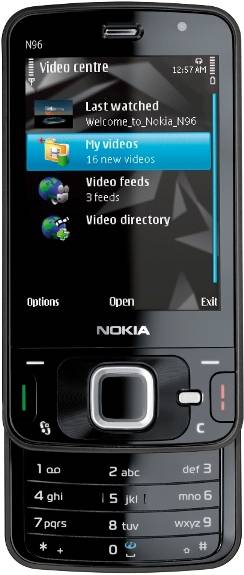
Nokia Nokia's N96 has one of the best video cams in a cell phone, with digital video stabilization and an "easy resume" feature. The phone was listed recently for $579 at Nokia's online store.
"You always have a cell phone on you, and even a Flip (camcorder) is a bit too bulky to carry in your pocket at all times; it generally goes into a bag of some kind," said Avi Greengart, consumer devices research director for Current Analysis. "The other advantage a cell phone has is built-in connectivity. While a Flip makes sharing or uploading a movie a simple process, you still need to wait until you can dock it with a PC. With a cell phone and a data plan, you can share or upload immediately." Still, you won't find the kind of image resolution and quality, frames-per-second rate and optical zoom on phone video cameras that you will on dedicated camcorders. "High-end (video) camera phones top out around 640-by-480 (pixels) at 30 frames per second, but even that is still quite rare, and none have optical zoom or high-quality glass lenses," he said. "At the other extreme, high-end camcorders can take high-definition digital video good enough for a low budget Hollywood film." In general, a guide to resolution numbers, according to Greengart: "320-by-240 is roughly VHS resolution, 640-by-480 starts to approach DVD resolution and 720-by-480 — often called “high definition” for video-recording purposes — is equivalent to widescreen DVD," with true high-definition TV being either 1280-by-720 or 1920-by-1080. "If you’re recording for YouTube, 320-by-240 is fuzzy but quite common, and 640-by-480 is more than sufficient," he said. "If you’re recording for playback on an HDTV, anything less than 720-by-480 will look blocky or blotchy." Storage, too, is another issue, with video files taking up lots of room, which can become a precious commodity on a mobile phone. "On a phone you might want to use a chunk of that memory card for music, photos, contacts, or applications, while the camcorder is used mostly just for video," Greengart said. "And then there’s battery life: at the end of the day, if your camcorder battery runs out in the middle of nowhere, you can still use your phone to call a cab. If your video recording session drains the battery on your cell phone, you’re stuck without a phone." But for those who want to leave the full-featured camcorder, or even the Flip, at home, there are some phones that can do the job when it comes to video, as long as you don't mind compromises. Here's a look at some of them: Nokia N96. This may be one of the premier cell phones for video recording, and perhaps one of the most expensive, at $579, as priced recently at Nokia's Web site. (The phone is sold by Nokia in the |
|
|
|
|